How do you select a shaft coupling?
NBK selects in four steps. First determine the coupling type from the application. Then select a material suited to the operating environment. Then choose a size that fits the transmitted torque, the available space and the shaft bores. Finally, determine how the coupling is fastened to the shaft.
Step 1 — Is this motion control or power transmission?
Everything follows from this one question, because it decides which property you are optimising for.
Motion control means a servomotor or stepping motor driving a ball screw or a stage, where positioning accuracy is the whole point. NBK is blunt about the consequence: it is “essential to select a type without chatter in the rotation direction, or in other words, a zero backlash type.” Any play between the hubs is positioning error you cannot compensate.
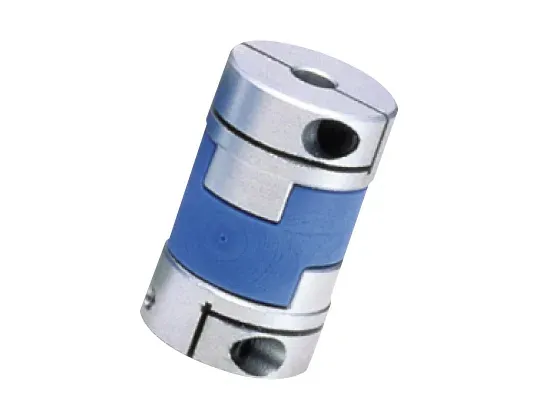
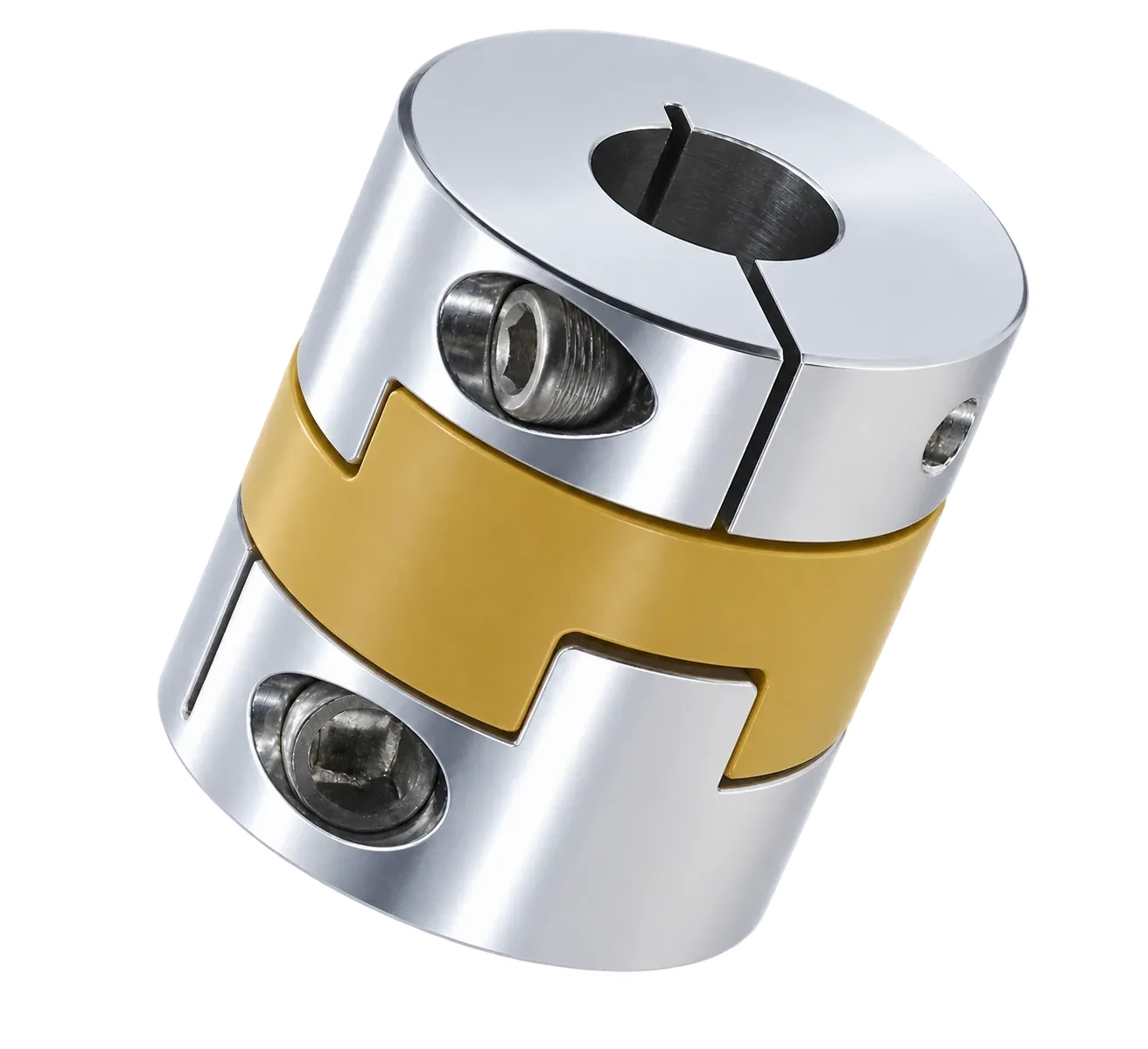
Power transmission means a general-purpose motor moving a pump, a mixer or a conveyor. Here you are buying torque capacity and misalignment tolerance, not micrometres. NBK’s default here is the jaw coupling; where misalignment is larger than a jaw can take, the Oldham type is the answer — it has the highest allowable misalignment of any type in the range.
One correction worth knowing, because it overturns older textbooks. For servo applications, disc couplings used to be the reflex choice for their all-metal rigidity. NBK now says otherwise: “now that motor performance has dramatically improved, high-gain rubber couplings are ideal.” The rubber types damp the resonance that forces you to lower the servo gain — which is a bigger win than raw torsional stiffness. The next article in this series measures exactly that.
What each type is actually good at
| Coupling type | Zero backlash | Allowable misalignment | NBK’s one-line verdict |
|---|---|---|---|
| High-gain rubber (XGT2) | Yes | Good | Best suited for servomotors |
| Disc (XHW · XHS) | Yes | Good | Second only to rubber for servo performance |
| Slit (MST · MSX) | Yes | Weak | Classical type, also custom made |
| Bellows (MFB · MFBS) | Yes | Good | Best suited for encoders |
| Oldham (MOR · MOM) | No | Best in range | High allowable misalignment |
| Jaw (MJC · MJS · MJB) | Limited — see below | Good | Best suited for power transmission |
| Cross joint (XUT) | Near-zero | Good | Reduces load on the shaft |
| Serration (MSF) | No | Good | Low cost, general-purpose motors |
| Rigid (MRG · MRGS) | Yes | None | Highly coaxial fastening |
NBK’s own comparison, simplified by NBK itself: “Each type of coupling introduced has a performance range of torsional rigidity, etc., depending on the coupling size and material.” Source: Couplings Basics Brochure, p. 3–4.
Step 3 — Size on torque, then correct for temperature
Two torque figures appear in every NBK table. Rated torque is what the coupling transmits continuously; max. torque is what it survives momentarily — for most series exactly twice the rated value.
Here is the part that saves you a calculation: NBK states that rated torque “allows for load fluctuations during operation, so rated torque compensation is not required when making a selection.” There is no service factor table in the catalogue because you are not meant to need one. Select so that the load torque in continuous operation stays below the rated torque, and you are done.
With one exception, printed in the Oldham tables: those ratings assume no load fluctuation and rotation in a single direction. If your Oldham application reverses, or the load swings, size up.
The correction that is mandatory is temperature. Above 30 °C ambient, both rated and max. torque must be multiplied by a correction factor — and it bites hard, because 40 °C inside a cabinet is not exotic.
Temperature correction factor
| Ambient temperature | XGT2 · XGL2 · XGS2 | MJC · MJS · MJB · MSF |
|---|---|---|
| Up to 30 °C | 1.00 | 1.00 |
| 30–40 °C | 0.80 | 0.80 |
| 40–60 °C | 0.70 | 0.70 |
| 60–120 °C | 0.55 | Not rated — 60 °C is the limit |
Multiply both rated and max. torque by this factor. Allowable operating range: XGT2/XGL2/XGS2 −10 to 120 °C; MJC/MJS/MJB and MSF −20 to 60 °C. Source: Catalogue section “Shaft couplings”, p. 39–40, 131–132, 205–206.
Shortcut: coupling size by servomotor rated output
| Rated output | Rated torque | XGT2 / XGL2 | XHW (disc) |
|---|---|---|---|
| 10 W | 0.032 N·m | 15C | 19C |
| 50 W | 0.16 N·m | 19C | 19C |
| 100 W | 0.32 N·m | 19C | 19C |
| 200 W | 0.64 N·m | 30C | 27C |
| 400 W | 1.3 N·m | 30C | 34C |
| 750 W | 2.4 N·m | 39C | 39C |
NBK’s recommended sizes, for direct drive without reduction gears; motor data are general values. Also valid for servomotors with 350 % instantaneous max. torque. Source: Catalogue section “Shaft couplings”, p. 21–22.
Step 4 — How the coupling grips the shaft
NBK offers seven fastening methods. In practice most designs come down to a choice between the first two.
- Set screw — the cheapest and most common. The catch is stated plainly: the screw tip contacts the shaft directly, “possibly scratching it or making it difficult to remove.”
- Clamping — the screw compresses the bore around the shaft. “Mounting and removing are easy and there is no risk of scratching the shaft.” For anything you will service, this is worth the money.
- Split and semi-split — the bore opens fully, so the coupling comes off without moving the motor or the driven machine.
- Key — for higher torque, but never alone: it must be combined with a set screw or clamp to stop axial movement.
- Bushing — a taper’s wedge effect; the choice for machine-tool spindles.
- Adapter + clamping — for the 1/10 taper shafts found on some servomotors.
One dimension decides whether any of it works: the shaft. NBK’s recommended shaft tolerance is h6 or h7, and the shaft must be inserted to the full hub length given in the table — too short and the shaft slips or the clamp breaks, too long and the shafts collide inside the coupling.
The three types that cover most machines
Servo positioning, all-metal rigidity, or brute torque with a forgiving sleeve — start here.
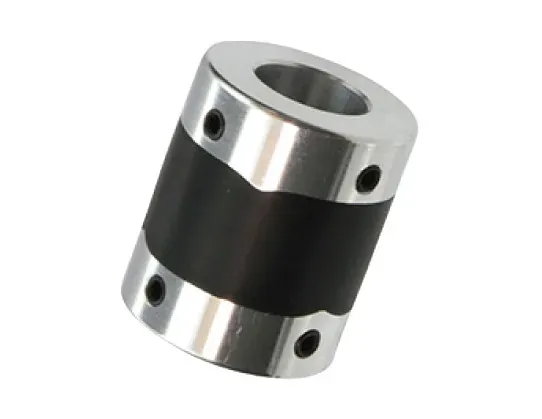
High-Gain Rubber Coupling (XGT · XGL · XGS)
Zero-backlash elastomer coupling that combines high torsional stiffness with superior vibration and shock damping, ideal for dynamic servo drives.
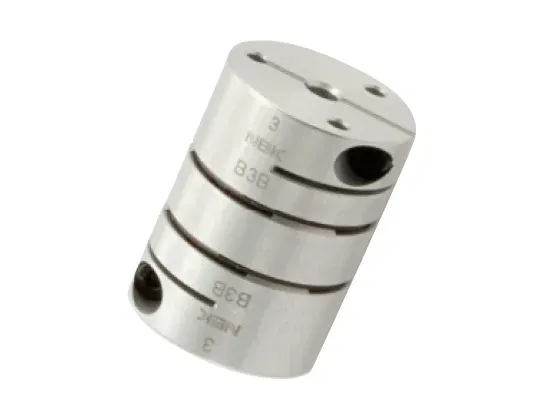
Backlash-Free Disc Flexible Coupling (XHW · XHS · XHW-L)
Zero-backlash stainless-steel disc coupling with very high torsional stiffness for high-speed, high-precision servo and stepper positioning.
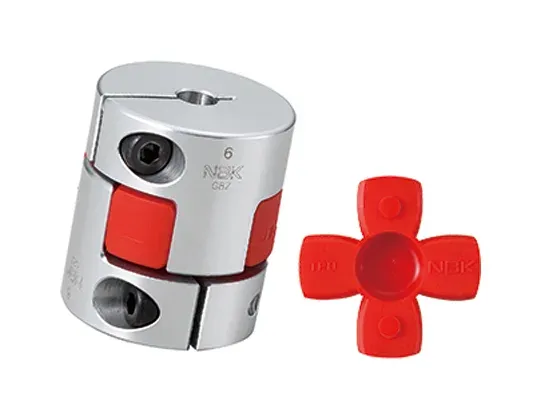
Jaw Type Flexible Shaft Coupling (MJC · MJS · MJB)
Elastomer-jaw coupling that transmits high torque while absorbing vibration and misalignment: zero backlash with tight-fit sleeves and electrical insulation.
Not sure which one your machine needs?
Send us the torque, speed, misalignment and environment. Our engineers come back within 24 hours with a concrete recommendation — and a sample if you want to test it.