
Article codes
3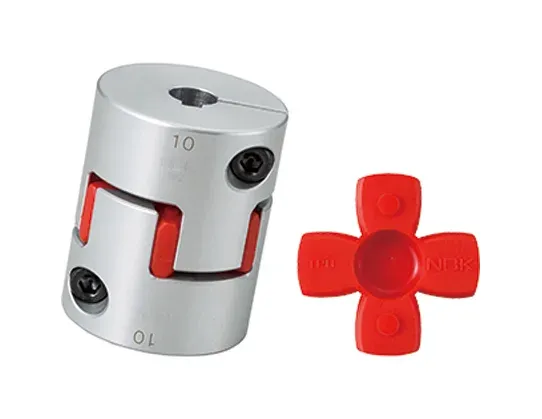
Coupling for motion control
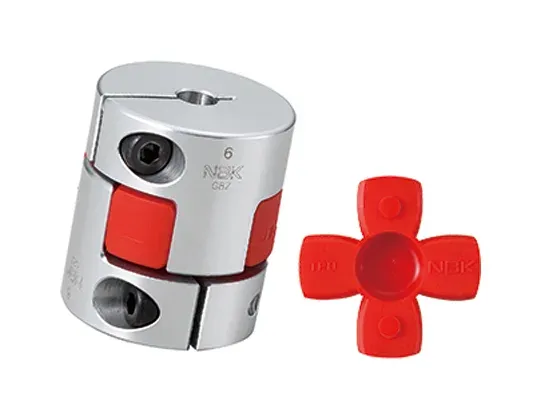
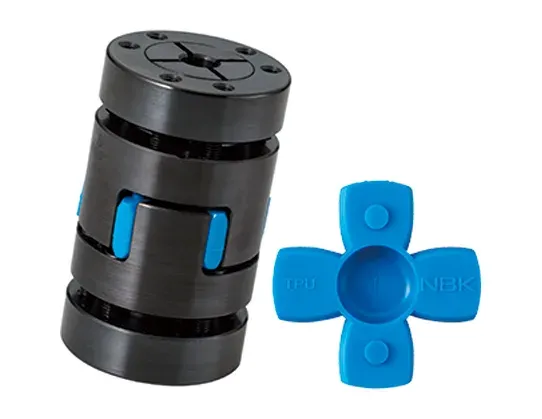
Jaw Type Flexible Shaft Coupling (MJC · MJS · MJB)
Elastomer-jaw coupling that transmits high torque while absorbing vibration and misalignment: zero backlash with tight-fit sleeves and electrical insulation.
- Jaw type
- General purpose motor
- Stepper motor
- Servo motor
- High torque
- Vibration absorption
Which coupling transmits high torque and still damps vibration?
A jaw type coupling like the NBK MJC/MJS/MJB transmits high torque while damping vibration. An elastomer sleeve between two metal hubs absorbs angular, parallel and axial misalignment, dampens shock and provides at least 2 MΩ electrical insulation. Sleeves come in four hardness grades; a tight-fit sleeve gives zero backlash for dynamic servo motion, while an easy-fit (suffix E) sleeve speeds assembly. It suits all motor types across an operating range of −20 °C to 60 °C.
Features
- Zero backlash in low-torque applications
- Excellent absorption of torsional vibration and parallel/angular misalignment
- Tight-fit and easy-fit sleeves available
- Different sleeve hardnesses available
- Oil resistance and electrical insulation
- Identical clockwise and counter-clockwise characteristics
- Operating temperature −20 °C to 60 °C
- Usable with all motor types
Overview
Jaw type shaft couplings are known for transmitting high torque while accommodating shaft misalignment. The range comprises three designs: MJC, MJS and MJB. Elastomer sleeves are available in four colours, each a specific hardness, in a tight-fit version for zero backlash or an easy-fit version for quick assembly. The couplings provide an electrical insulation resistance of at least 2 MΩ, achieved by the elastomer sleeve between the hubs, which also damps vibration.
Working principle
Torque is transmitted via an elastomer sleeve positioned between two metal hubs. The sleeve accommodates angular, parallel and axial misalignment, dampens vibration and shock loads, and provides electrical insulation, protecting connected components such as motors and ball screws. A tight-fit sleeve ensures zero backlash, making jaw couplings well suited to dynamic servo-driven motion control.
Tight-fit vs. easy-fit sleeves
Tight-fit sleeves are used in zero-backlash applications; they transmit high torque with high dynamic strength (XY stages, indexing tables, machine tools, factory automation, injection moulding) and are standard (no suffix). Easy-fit sleeves (suffix E) enable quick assembly, because one hub can be mounted first and the sleeve plus second hub fitted later; they suit conveying systems, mixers, fans, pumps and dispensers.
- Type
- Jaw type
- Outside Ø range
- Ø14 – 95 mm
- Bore diameter
- 3 – 55 mm
- Rated torque
- 4 – 560 Nm
- Hub material
- Aluminium (MJB: steel, black-oxide finish)
- Motor type
- Used for all motors
Ready to specify this coupling?
Send us your bore, torque, speed and environment. Our engineers in Dedemsvaart match the right article code and quote it.