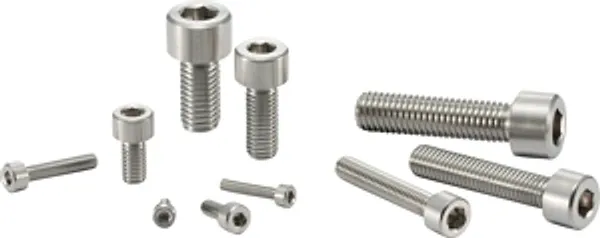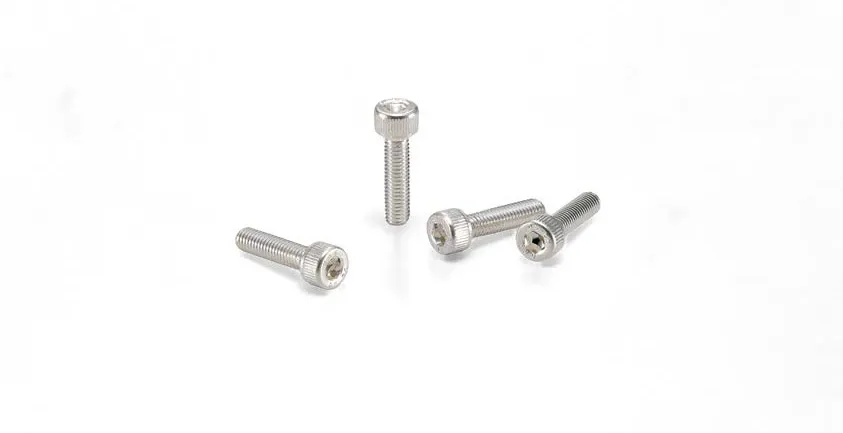
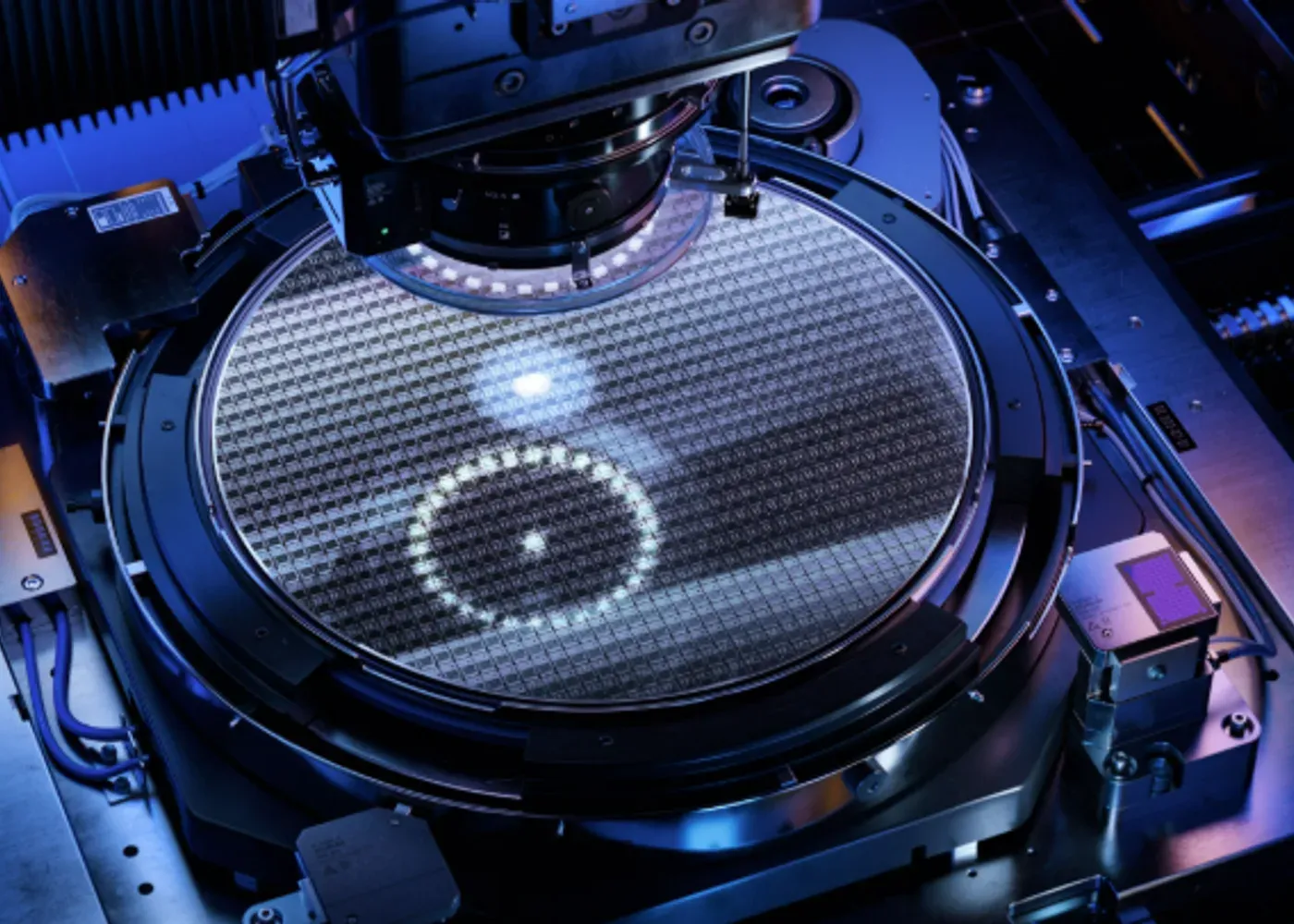
What is a vacuum-compatible (vented) screw?
A screw with a ventilation hole through it. NBK: “The ventilation hole easily releases gas trapped in the screw holes of equipment and machines, and supports vacuum drawing of vacuum devices.” Without it, air sealed at the bottom of a blind hole leaks slowly into the chamber and delays pump-down.
The virtual leak nobody drew
Screw a plain cap screw into a blind hole and you have created a sealed cavity: the air below the screw tip can only escape along the thread flanks. It does escape — slowly, unpredictably, over hours — and while it does, your gauge reads a pressure that has nothing to do with a real leak. Hunt for the leak and you will not find it, because it is inside your own fastener.
NBK’s answer is mechanical and unglamorous: put a hole through the screw. The gas at the bottom of the hole leaves through the axis of the screw instead of seeping past the threads. The company is careful about how it makes the hole, too: “Ventilation holes are made using a method that has little effect on metal structure. The occurrence of outgas under vacuum environment and brittle fracture during usage are suppressed respectively.”
The same logic applies one layer out. The clearance hole in the part being fastened also traps gas — so NBK makes washers with ventilation grooves (SWAS-VF in stainless, SWAT-VF in titanium) that vent the drilled hole itself.
The vented lineup
| Series | Material | Strength class | Sizes |
|---|---|---|---|
| SVSS | SUSXM7 (SUS304 equiv.) | A2-70 | M2 – M12 |
| SVSS-PC | SUSXM7, chemically polished | A2-70 | M3 – M12 |
| SVSL | SUS316L | A4-70 | M3 – M12 |
| SVSX | SUS316L HiMo (high strength) | 8.8 | M3 – M6 |
| SVST | Titanium TB340C (Grade 2) | — | M3 – M5 |
| SVSQS | SUSXM7 + captive washer | A2-70 | M3 – M12 |
| SWAS-VF | Washers with ventilation grooves | — | — |
Every vented product page carries the same application line: “Vacuum devices, vacuum chambers, FPD production equipment, semiconductor devices, and electron microscopes.” Source: NBK product catalogue, section “Special screws”, p. 565–590.
Cleanroom washing: what you actually get
NBK will wash and pack the parts for you, and the service is specified rather than promised. The washing room is ISO Class 7. The washed parts are then packed inside the cleanroom, in vacuum double packaging.
You choose the method, and it becomes a suffix on the part number — SGPS-M6-20-PL-USC, for example:
- USC — ultrasonic cleaning. Ultrasonic wash, second ultrasonic wash, ultrasonic rinse, pure-water rinse, dry, vacuum double pack. Suited to rust-resistant materials such as stainless steel.
- IPA — isopropyl alcohol. IPA dip, second IPA dip, dry, vacuum double pack. Suited to rust-prone materials such as steel.
NBK verifies the result rather than asserting it: parts are washed in ultrapure water and the particles released are counted with an automatic liquid particle counter. Residual oil is measured periodically, and NBK commits to ≤1 mg/ft² after USC cleaning (measured: 0.3 mg/ft², against 1.5 mg/ft² for IPA).
Two practical limits. A single cleanroom wash and pack handles parts up to 250 × 300 × 100 mm. And parts already carrying the “Cleanroom Wash & Packaging” icon in the catalogue arrive cleaned and packed as standard — for everything else it is an option, sometimes at additional charge.
Particles released after washing (test sample SUS303, ⌀19 × 20 mm)
| Particle size | USC (ultrasonic) | IPA | Untreated |
|---|---|---|---|
| ≥ 0.3 µm | 220,000 | 7,000,000 | 210,000,000 |
| ≥ 0.5 µm | 51,000 | 1,900,000 | 37,000,000 |
| ≥ 1.0 µm | 3,100 | 160,000 | 1,400,000 |
| ≥ 2.0 µm | 280 | 29,000 | 240,000 |
Counts in pieces, by automatic liquid particle counter. NBK: “The values in the table are actual test values and are not guaranteed values.” Ultrasonic washing removes roughly three orders of magnitude of sub-micron particles compared with an untreated screw. Source: NBK — Cleanroom washing and packaging service.
Galling, without the contamination risk
Stainless on stainless galls. In a clean, dry vacuum chamber it galls worse, because the oxide films and adsorbed moisture that normally act as a boundary lubricant are simply not there — NBK notes that in a vacuum the friction coefficient goes up and seizing becomes more likely.
The usual fix is a coating: MoS₂, PTFE, black chrome. In a process chamber that fix creates a new problem, and NBK states it plainly: “Surface coated screws, the conventional countermeasure, cannot be used because of the risk of contamination due to coating peeling.” A flake of MoS₂ on a wafer is a scrapped wafer.
The answer is to change the steel instead of covering it. NBK’s surface-hardened screws (SNSL-PN in SUS316L, SVSL-PN vented, and the tantalum SNSTA) are cured by NBK’s own process: “There is nothing adhering to the surface, eliminating concerns about contamination due to stripping.” They resist galling without lubricant, they stabilise the axial force, they work hot, and they are a drop-in replacement in M3 to M8.
The screw that must not fall
NBK puts the cost plainly: “The interior of semiconductor manufacturing equipment is an extremely complex space. A single screw or washer falling into the equipment during assembly or maintenance can affect its quality, requiring a painstaking search.”
Captive screws solve it mechanically. A relief cut in the thread catches on the screw hole, so the screw stays with the panel even when fully unscrewed. NBK also sells the retrofit: SWAS-SC captive washers turn a commercial screw into a captive assembly.
And this is not only good practice — for machine guards it is European law. The EU Machinery Directive 2006/42/EC, Annex I, §1.4.2.1: “Fixed guards must be fixed by systems that can be opened or removed only with tools. Their fixing systems must remain attached to the guards or to the machinery when the guards are removed.” A captive screw is the simplest way to comply.
The three families this article is about
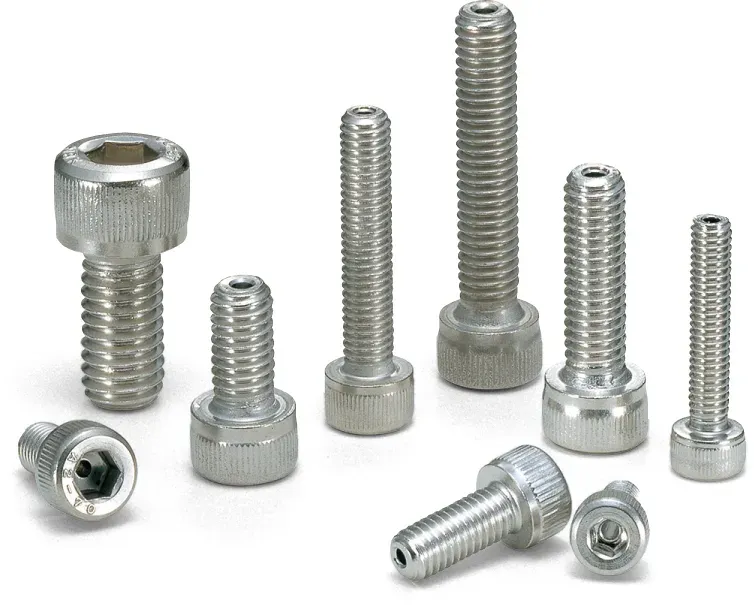
Vacuum-Vented Screws
Vented (drilled) socket-head cap screws that release trapped air and gases during pump-down to prevent virtual leaks in vacuum and cleanroom systems.
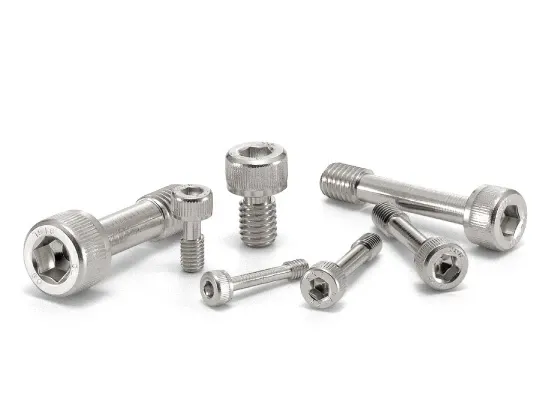
Captive Screws
Captive screws stay permanently attached to the component, preventing loss during operation and maintenance of covers, panels and access points.
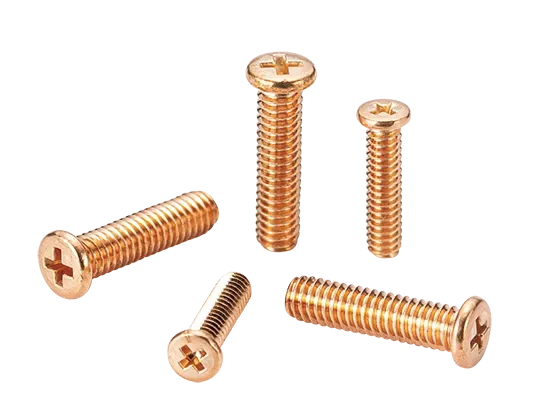
Non-Magnetic Screws
Low-permeability fasteners in titanium, SUS316L HiMo, tantalum, phosphor bronze and brass for MRI, cryogenic, semiconductor and precision magnetic instruments.
Not sure which one your machine needs?
Send us the torque, speed, misalignment and environment. Our engineers come back within 24 hours with a concrete recommendation — and a sample if you want to test it.