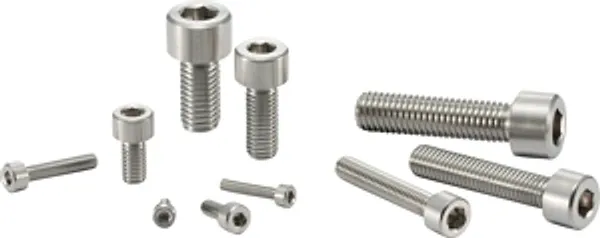
How do you choose the material for a special screw?
Start from the one property the standard screw fails on — strength, temperature, magnetism, chemical attack or seizing — and select on that alone. Then check the others do not become the new failure. NBK’s ranges are wide enough that optimising for one property rarely costs you the rest.
Strength: how much more you actually get
Standard stainless is not strong. A4-70 (SUS316L) reaches 700 N/mm² tensile, and the A2-70 grade the same — which is why so many stainless designs are oversized in diameter to make up for it.
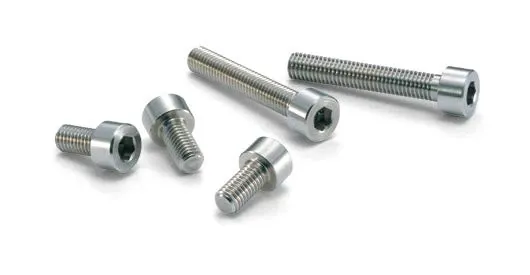
NBK’s high-strength stainless, SNSX, is made from SUS316L HiMo: reduced carbon, more chromium, nickel and molybdenum. It comes in class 8.8 (800 N/mm² tensile, 640 N/mm² proof) and class 10.9 (1,000 and 900). It stays non-magnetic, and it keeps a usable proof stress hot: 448 N/mm² at 600 °C for the 8.8, and 765 N/mm² for the 10.9.
The point is not the number, it is what the number buys. NBK gives the worked example: swapping to high-strength stainless let a flange go from M6 to M4 bolts at the same clamping force, and the flange itself shrank from ⌀80 mm to ⌀75 mm and from 10 mm to 7.5 mm thick. Strength per screw becomes space and weight saved in the machine.
Tensile strength and magnetism, at room temperature
| Screw / material | Tensile strength | 0.2 % proof stress | Magnetic? |
|---|---|---|---|
| SNSX-109 — SUS316L HiMo, class 10.9 | 1,000 N/mm² | 900 N/mm² | No |
| SNSX-88 — SUS316L HiMo, class 8.8 | 800 N/mm² | 640 N/mm² | No |
| SNSTG — Ti-6Al-4V titanium | ≥ 895 N/mm² | ≥ 825 N/mm² | No (µ 1.0002) |
| SNSL — SUS316L, A4-70 | 700 N/mm² | 450 N/mm² | No |
| SNHDS — duplex UNS S31803 | ≥ 620 N/mm² | ≥ 450 N/mm² | Yes |
| SNSJ — SUS310S | 520 N/mm² | 205 N/mm² | No |
| SNST — pure titanium (Grade 2) | 340–510 N/mm² | ≥ 215 N/mm² | No (µ 1.0001) |
NBK notes these mechanical properties are “for reference only, not guaranteed”. Titanium Ti-6Al-4V also weighs about 60 % of stainless steel. Source: NBK product catalogue, section “Special screws”, p. 621–626, 633–634.
Tensile strength at temperature
| Material | 200 °C | 500 °C | 800 °C |
|---|---|---|---|
| Molybdenum (SNSM) | 590 N/mm² | 450 N/mm² | 290 N/mm² |
| SUS310S (SNSJ) | 580 N/mm² | 500 N/mm² | 200 N/mm² |
| Inconel 600 equiv. (SNSI) | 560 N/mm² | 530 N/mm² | 200 N/mm² |
| SUS316L | 560 N/mm² | 500 N/mm² | 250 N/mm² |
| SUS304 | 500 N/mm² | 420 N/mm² | 160 N/mm² |
| Carbon steel | 450 N/mm² | 230 N/mm² | 40 N/mm² |
At 1,000 °C only two are left standing: molybdenum at 210 N/mm² and Inconel 600 at 70. Ceramic (Al₂O₃ 99.5 %) and SiC screws have a continuous operating temperature of 1,500 °C, but are brittle. Source: NBK product catalogue, section “Special screws”, p. 553–554.
Non-magnetic: “stainless” is not an answer
Austenitic stainless is often called non-magnetic, and for a fridge door it is. For an electron beam it is not: cold working during thread rolling raises the permeability, and the A2 grade NBK measures comes out at µ 1.4 — enough to deflect the beam in an SEM or an ion implanter, or to become a projectile near an MRI magnet.
Titanium and phosphor bronze are in another class entirely: amplitude permeability 1.0001, with a magnetic flux density measured at 0 T where the A2 stainless reads 5 × 10⁻⁵ T. NBK measured both with an F.W. Bell 5080 gauss/tesla meter in DC mode, at 5 mm from the sample.
And remember the tool. NBK sells titanium hex keys (SKHTG) and a CFRTP adjustable wrench (SKMWCP-200) precisely because, near an MRI magnet, “tools are strongly attracted to the magnetic field, posing a danger”. A non-magnetic screw fitted with a steel Allen key in an MRI room is a solved problem replaced by a worse one.
Amplitude permeability
| Material | Amplitude permeability µ | NBK screws |
|---|---|---|
| Pure titanium (TB340C / TW270) | 1.0001 | SNST, SNPT, SNFT, SVST |
| Phosphor bronze (C5191) | 1.0001 | SNSP |
| Ti-6Al-4V (64 titanium) | 1.0002 | SNSTG |
| SUSXM7 (A2 stainless, reference) | 1.4 | — |
Measured with an F.W. Bell 5080 gauss/tesla meter, DC field mode, probe 5 mm from the sample. Source: NBK product catalogue, section “Special screws”, p. 555–556, 633–634.
Chemicals: a ranking, not a promise
NBK does not publish a universal corrosion table, and it is right not to: resistance depends on concentration, temperature and time. What it does publish is an ordinal ranking, which is exactly what you need to build a shortlist.
Metals, most resistant first: MAT21 → Hastelloy C-22 equiv. → Hastelloy C-276 equiv. → Monel 400 equiv. → titanium → Inconel 600 equiv. → duplex stainless → SUS316L HiMo → SUS310S.
Plastics, most resistant first: PTFE → PFA → PVDF → H-PVC → PP → PEEK.
Two data points are worth keeping. In sulfuric acid at 50 °C, SUS304 corrodes at 1.08 mm/year in 3 % concentration, where SUS316/316L reads 0 — and the SNSX HiMo grade holds at 0 in both 3 % and 10 %. And alumina ceramic (Al₂O₃ 99.5 %) shrugs off boiling 98 % sulfuric acid, boiling 70 % nitric acid and boiling 35 % hydrochloric acid — but is heavily corroded by potassium fluoride at 90 °C. There is no universally resistant material; there is only the right one for your chemistry.
The rule that governs all of it: preload, not torque
A screw does not hold with torque. It holds with the axial force that torque produces — and how much of your torque becomes axial force depends almost entirely on friction in the thread.
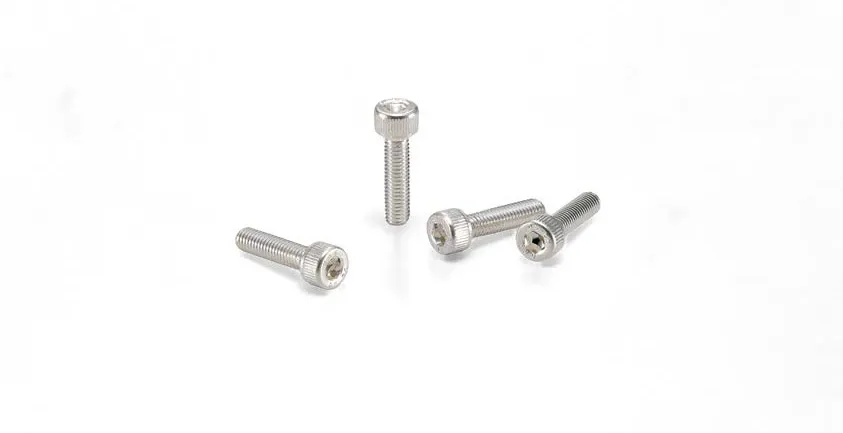
NBK measured it on the same screw: an M5 socket head cap screw, class A2-70, tightened to 5 N·m. Untreated, it develops 2.3 kN of clamp load. The same screw with low-temperature black chrome develops 9.2 kN. Four times the preload from the same wrench setting, because the friction coefficient collapsed.
This cuts both ways, which is why it is a warning as much as a feature. If you specify a coated screw and keep the torque figure from the uncoated one, you may take the joint past yield. NBK gives the design rule: for class A2-70 the 0.2 % proof stress is 450 N/mm², and “it is recommended to use at an axial force at which stress at tightening is 70 % or less” of it. Change the surface, recalculate the torque.
The mechanism is worth knowing, too: “The main cause of seizing is frictional heat on the thread peak surface generated during tightening.” Lower the friction and you lower the heat — which is why the same treatments that raise preload also prevent galling.
Same screw, same 5 N·m — different surface
| Surface treatment | Axial force | Stress at tightening |
|---|---|---|
| None | 2.3 kN | 146 N/mm² |
| Gold coating (SNSS-AUS) | 4.3 kN | 273 N/mm² |
| Fluorine coating (SNSS-FC) | 5.0 kN | 317 N/mm² |
| Molybdenum disulfide (SNSS-MO) | 6.7 kN | 425 N/mm² |
| PTFE coating (SNSS-TF) | 8.7 kN | 552 N/mm² |
| Low-temp. black chrome (SNSS-RY) | 9.2 kN | 584 N/mm² |
Test piece: stainless socket head cap screw M5 × 25, class A2-70, tightened to 5 N·m. Note that the last two exceed 70 % of the 450 N/mm² proof stress — at this torque they are over NBK’s own recommendation. Source: NBK product catalogue, section “Special screws”, p. 671–672.
Pick the property, then the screw
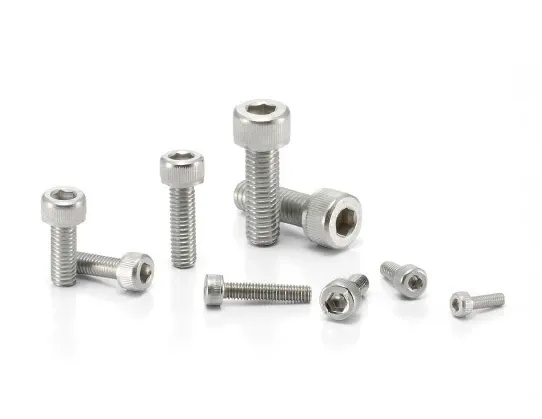
High-Strength Screws
High-strength fasteners in Grade 5 titanium, SUS316L, chrome-molybdenum steel, aluminium and RENY plastic that let designers downsize while keeping fastening strength.
Heat-Resistant Screws
Fasteners for service far beyond 200 °C: SUS316L, molybdenum, ceramic, Vespel, Hastelloy and Inconel screws for furnaces, plasma and high-temperature process equipment.
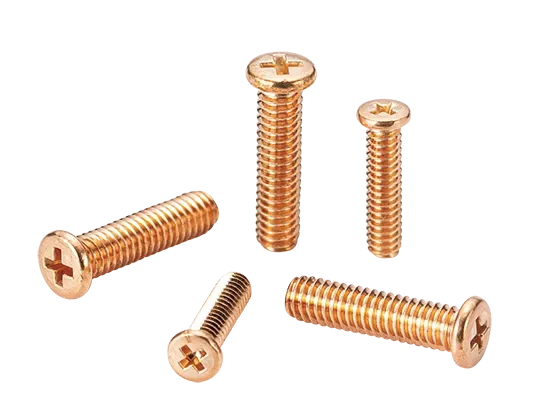
Non-Magnetic Screws
Low-permeability fasteners in titanium, SUS316L HiMo, tantalum, phosphor bronze and brass for MRI, cryogenic, semiconductor and precision magnetic instruments.
Not sure which one your machine needs?
Send us the torque, speed, misalignment and environment. Our engineers come back within 24 hours with a concrete recommendation — and a sample if you want to test it.